Michael Downey
Down Cemetery RoadMichael Downey’s return turns an official death into a living threat and a second chance at rescue. Presumed dead for four years after a helicopter crash near Cyprus, he is in fact a survivor of a secret desert chemical-weapons experiment. His survival has left him capable of extraordinary control and lethal violence, but not untouched: the exposure that helped make him a government test subject is eventually revealed to be fatal. His search for Dinah Singleton, whom he believes may be his daughter, brings the novel’s questions of secrecy, parentage, and the cost of survival into one unresolved human bond.
Identity and the Official Death
Downey enters Sarah Trafford’s investigation first as a name in an old newspaper photograph. The image shows Thomas Singleton and another uniformed man, both relaxed and smiling; Thomas holds a cigarette, and the companion is identified as Michael Downey. The two had been in the same helicopter, reported to have crashed off Cyprus. Joe Silvermann recognizes the possibility that Downey, like Thomas, may still be alive. Sarah connects the photograph to the man who had been waiting for her in a car park: the supposed dead soldier is already entangled in the present search for Dinah.
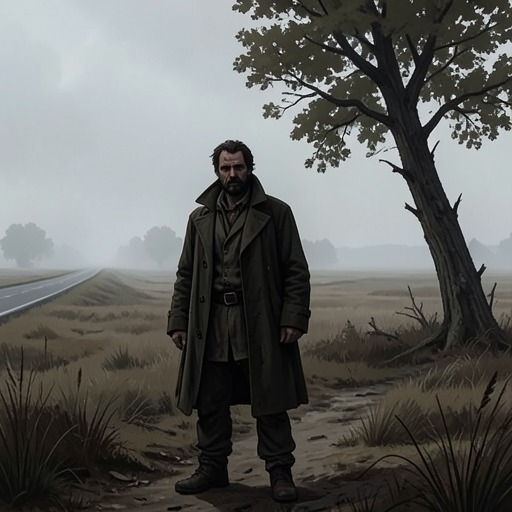
The physical description circulating later gives him a recognizable outline: about six feet tall, in his late thirties, well-built, with a stringy dark beard and a ponytail tied with a red band. He carries a blue canvas bag and wears a denim jacket. The details make him identifiable, but they also suggest the difficulty of fixing him in place: his appearance can be altered, and his official identity has already been erased by a false account of his death.
When Sarah tells him that he has been dead for four years because of the helicopter crash, Downey says he has never been to Cyprus. The elapsed time registers with visible surprise. The contradiction between the public report and his own recollection is not merely a mistaken record: it points toward the concealed military history that he gradually explains. His past is thus disclosed in fragments, as Sarah’s pursuit of Dinah intersects with the story that the authorities have buried.
Reappearance and Escape with Sarah
Downey becomes central to Sarah’s immediate survival after a man tries to kill her. He shoots the attacker, then tells Sarah plainly that he is the person who shot the man who tried to kill her; he adds that he would have killed him anyway. The intervention saves her, but it does not offer comfort or restore ordinary choices. Sarah has little money, having taken only her wallet from the house, and finds herself responding to events she has not controlled.
Downey disposes of the murder weapon with deliberate care. Between the house and the railway station, he drops the gun, its silencer, and its ammunition into three separate drains. His movements are so fluid that a watcher might struggle to distinguish the actual disposal from a practiced feint. The sequence shows both his military composure and the danger surrounding his protection: Sarah is being kept alive by a man who knows how to remove the traces of a killing.
Their first plan is essentially flight. Downey has bought two single tickets to Birmingham and covered their tracks as they leave. He pulls the band from his ponytail, lets his dark hair fall around his face and shoulders, and makes himself harder to recognize. On the train, he connects Sarah to two earlier moments: she had been on the bridge after Thomas was killed, and later at the hospital looking for Dinah. Their alliance begins not with trust freely established, but with his recognition that her search has brought her into the same dangerous history.
That history also makes Downey a possible instrument of false explanation. After Joe is killed and Sarah is warned off, she recalls the man in the car park and imagines him as someone who could have slit Joe’s throat. She considers tarnishing Joe’s name. The thought belongs to Sarah’s fear and the pressure being applied to her, not to a revealed account of Joe’s murder; its importance is that Downey’s supposed death and violent reputation can be exploited to distort the truth as readily as the authorities’ cover story can.
The Desert Experiment and Its Survivors
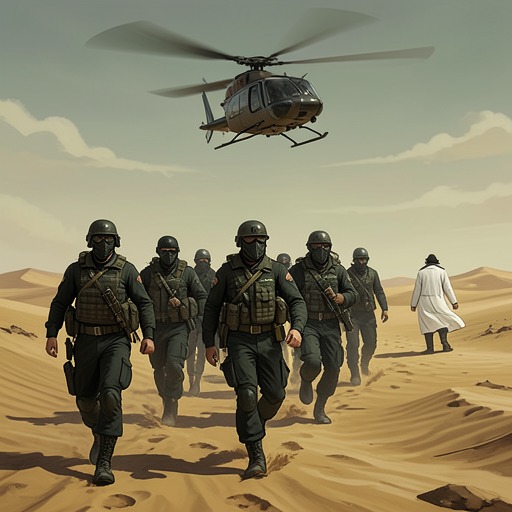
In conversation with Sarah, Downey begins to explain the desert. The helicopter, he says, was one of their own, though at the time he was tied to a bed and wondered whether he had misunderstood what had happened. He and the others had been used as guinea pigs in an experiment involving a chemical agent. A substance painted on them was supposed to protect them. The soldiers had heard stories during the war of a weapon called the Patriot Bomb, imagined as a device that could kill an enemy without killing one’s own troops. Downey doubts that such a weapon truly exists, but recognizes that people have continued trying to create it.
His account makes the supposed crash part of a larger concealment: the official story of his death has helped hide what happened to the soldiers in the desert. Downey did not escape with a whole company. He tells Sarah that he and Tommy Singleton left; the others were dead. The starkness of that distinction gives his survival a double meaning. It is an escape from captivity, but also a life built in the aftermath of the deaths of the men who did not leave with them.
Years later, the experiment remains present in his body. Howard tells Zoë Boehm that Downey is dying from something he caught in the desert, an illness with a long course but a fatal outcome. The knowledge reframes his apparent control: he can discard weapons, evade identification, and cross dangerous ground, yet he cannot undo the delayed consequence of being made a test subject. The desert’s violence persists after the experiment itself, concealed in a survivor’s body rather than confined to a single blast.
Dinah, Thomas, and the Limits of Rescue
Downey’s search for Dinah is bound up with uncertainty about who her father is. He thinks she may be his, and others report that he believes she is. But blood testing establishes that Dinah is definitely Thomas Singleton’s daughter. The result separates biological fact from Downey’s attachment and hope; it does not settle what Dinah means to him, or what responsibility he feels toward her.
When Howard assesses what has happened on the island, he offers a tentative reconstruction: it looks as though Downey arrived, probably stole a boat, killed the guards, took Dinah, and left. The account is presented as an inference, not a witnessed report. Sarah’s later reflection adds a disturbing precedent: the last time the authorities put Downey on that island, he left bodies behind him. She wonders why they expected the same arrangement to end differently this time. Rescue and lethal force have become inseparable in the state’s attempt to use Dinah as bait and in Downey’s response to the people holding her.
At the reunion, Downey looks at Dinah and says that she resembles Maddy Singleton. Sarah sees the small blonde child with large green eyes looking back at her, then turning her attention toward Downey’s chest. His comparison links the child to the family and lost life around Thomas, while Sarah’s recognition of Dinah’s beauty makes the cost of using her as leverage newly immediate. Dinah is not simply the object of a search: she is a child whose vulnerability exposes the human consequences of the competing claims made over her.
Violence, Survival, and the Ending
Downey’s protection of Dinah does not make his violence easy to excuse. At sea, Sarah thinks of the bodies he has left behind and asks why those deaths were necessary. Zoë Boehm suggests that he believes Dinah is his; Sarah answers that he does not know. The uncertainty matters, but does not erase the consequences of his actions. His devotion is directed toward a child whose paternity is not his, and his rescue may be an act of care even as its methods leave death behind.
Sarah’s reflection widens from Downey’s immediate choices to the less visible damage carried forward from the desert. The sea erases the white scar of the boat’s wake, but Sarah thinks of invisible pollutants that do not disappear so cleanly. In Downey’s case, the lasting contamination is both physical and moral: the desert agent is killing him, while the history of institutional violence has made lethal action part of how he gets through a crisis. The metaphor does not make him an emblem detached from events; it draws together the delayed illness, the concealed experiment, and the bodies left in the wake of his attempts to save Dinah.
Downey ends the story alive and reunited with Dinah, but not restored to safety or certainty. He has brought her out of captivity, yet the evidence does not confirm that he is her father; the blood test identifies Thomas as her biological father. Nor does rescue cancel his terminal illness or resolve Sarah’s unease at the violence involved. His character holds these contradictions together: survivor and fugitive, rescuer and killer, presumed dead yet present, still reaching for a family connection that the facts cannot grant him.